


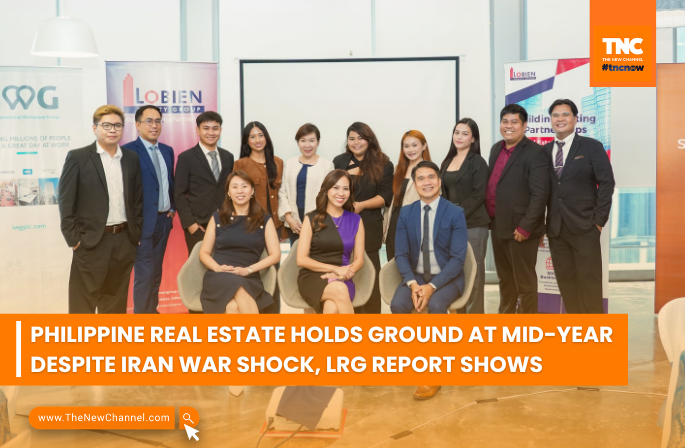
MANILA, PHILIPPINES, 9 July 2026 – The Philippine real estate sector is proving more resilient than the broader economy in the aftermath of the Iran War oil shock, according to the 2026 Mid-Year Market Outlook released by Lobien Realty Group (LRG) at a media briefing in Bonifacio Global City.
The country entered 2026 with inflation projected near the 3 percent target, the BSP policy rate at 4.5 percent and easing, and GDP growth forecast at 5.7 percent – among the fastest in Southeast Asia. That changed after the US-Iran conflict erupted, sending Q1 GDP growth down to 2.8 percent and inflation up to 6.8 percent, prompting the BSP to reverse course and hike rates again. LRG modeled three economic scenarios and assigns a 50 percent probability to a “fragile truce” base case, under which real estate should perform close to 2025 levels for the rest of the year.
“Real estate as a sector grew 6.8 percent year-on-year in the first quarter despite the headwinds -that’s one of the clearest signs that demand fundamentals remain intact,” said Sheila Lobien, LRG Chief Executive Officer.
Office: IT-BPM cements its lead
Metro Manila office vacancy remains at 19 percent in Q2 2026, with average rents marginally increasing to P1,000/sqm. IT-BPM firms now account for 52 percent of total office space leased, up from 45 percent two quarters earlier, and are projected to add 70,000 new employees this year, requiring at least 300,000 sqm of space. Supply remains disciplined, with only about 700,000 sqm expected between 2026 and 2029 – far below pre-pandemic new office supply of one million sqm annually from 2017 to 2019-cushioning further vacancy risk.
Outside Metro Manila, provincial office vacancy stood on par with the capital at 18 percent, as Cebu, Davao, and Pampanga draw demand alongside 25 DICT-designated “Digital Cities” nationwide, backed by the P9-trillion Luzon Spine Expressway Network.
LRG also flagged a structural risk: the rise of agentic Al. Although the Al initial impact is projected to be at least three to five years away, the country and the industry need to prepare and recalibrate. Under its “Managed Augmentation” scenario, the industry can maintain its medium-term baseline targets when Al is used in the front-end with humans doing escalated and more complex work. The “Human-in-the-Loop” (HITL) scenario, on the other hand, where the Philippines positions itself as a global Al-engine hub, the sector could scale and overshoot the aggressive target of the IT-BPM industry of 2.5 million FEs and $58 billion in revenues.
Residential: Balance GMA continues to have the highest loan share
Nationwide residential prices rose 4.5 percent year-on-year and 5.6 percent quarter-on-quarter in Q1 2026. Balance Greater Metro Area (GMA) – covering CALABARZON, Central Luzon and nearby provinces — now commands 40 percent of residential loans granted, versus 29 percent for NCR, driven by infrastructure along the Luzon Spine corridor, post-pandemic demand for larger homes, and pricing that runs 57 percent cheaper for houses and 32 percent cheaper for condominiums than NCR. NCR condominiums loans increased two percentage points, from 24 percent to 26 percent. Developers remain cautious on new condominium launches, deliberately managing supply after pandemic- and post POGO-era oversupply.
A key downside risk is on OFW remittances from the Middle East, which accounts for at least 14 percent of OFW remittances, which could be disrupted if the Iran conflict re-escalates.
Warehouse: Southern and Central Luzon continue to lead industrial growth
The Philippine warehousing market, valued at $441.7 million in 2025, is forecast to grow at a 5.2 percent CAR through 2034. Cavite, Laguna, and Batangas remain the most active corridors for occupier demand, while Clark and Central Luzon are emerging as the country’s fastest-growing logistics hub, aided by lower land costs, international airport access, and expressway connectivity. E-commerce growth, manufacturing expansion, and continued infrastructure investment are the primary demand drivers.
LRG’s outlook underscores that while the Philippine economy faces near-term stagflationary pressure from the Iran War. Real estate, particularly office and industrial, is positioned to remain a relative bright spot through year-end.
About Lobien Realty Group
Lobien Realty Group (LRG) is one of the Philippines’ fastest-growing independent commercial real estate consultancies, providing strategic advisory and transaction services across office, industrial, retail, investment, and project leasing. Founded by industry veteran Sheila Lobien, LRG combines deep local market intelligence with global best practices to help occupiers, landlords, developers, and investors make informed real estate decisions. Deeply Connected Locally. Thinking Globally. With an extensive network across Metro Manila and key growth markets nationwide, LRG delivers data-driven insights, strategic advice, and execution that create long-term value for its clients. www.lobiengroup.com
Want your story to be published? Subscribe to TNC via email partnerships@thenewchannel.com.
Follow TNC on Social Media FB – https://www.facebook.com/TNCnow/, IG – https://www.instagram.com/tncnow/, Tiktok – https://www.tiktok.com/@tncnow, LI – https://www.linkedin.com/company/thenewchannel/, X – https://x.com/tnc_now, YT – https://www.youtube.com/@TNCNow
Be updated on what’s new around the world, check your published stories by searching #TNCnow #OnTNC or check them out here: https://thenewchannel.com/highligh